
Open Saturdays • Se Habla Español | Call 956.630.6166
Children’s orthodontics in McAllen, TX, focuses on catching and guiding bite, jaw, and tooth problems while a child is still growing, and the best time for a first checkup is by age 7.
At A Perfect Smile Orthodontics, board-certified orthodontist Dr. David Taylor evaluates children of all ages and offers a free, no-obligation consultation, with no referral needed.
This guide covers when to bring your child in, the problems to watch for, underbites, baby teeth, early treatment, what happens at the first visit, and answers to common parent questions.
We welcome families from McAllen and across the Rio Grande Valley.
The American Association of Orthodontists recommends that children see an orthodontic specialist by age 7. That doesn’t mean your child will get braces at 7. At this age, an orthodontist can see how the jaws are growing and how permanent teeth are coming in, even while some baby teeth are still present.
Teeth that look straight can still hide a problem only an orthodontist can detect. A first check-up usually ends one of three ways:
When early treatment is the right call, it can help the orthodontist:
Older than 7? It’s not too late. Children, teens, and adults all benefit from a checkup, and our goal is to provide the right treatment at the right time.

Orthodontic problems can start before age 7. These bite and tooth problems, sometimes called malocclusions or “bad bites,” are the ones we see most often in growing children:

Other Signs Your Child Should See an Orthodontist
If you notice any of these, contact Dr. Taylor. You, your child’s dentist, and Dr. Taylor make final treatment decisions together.
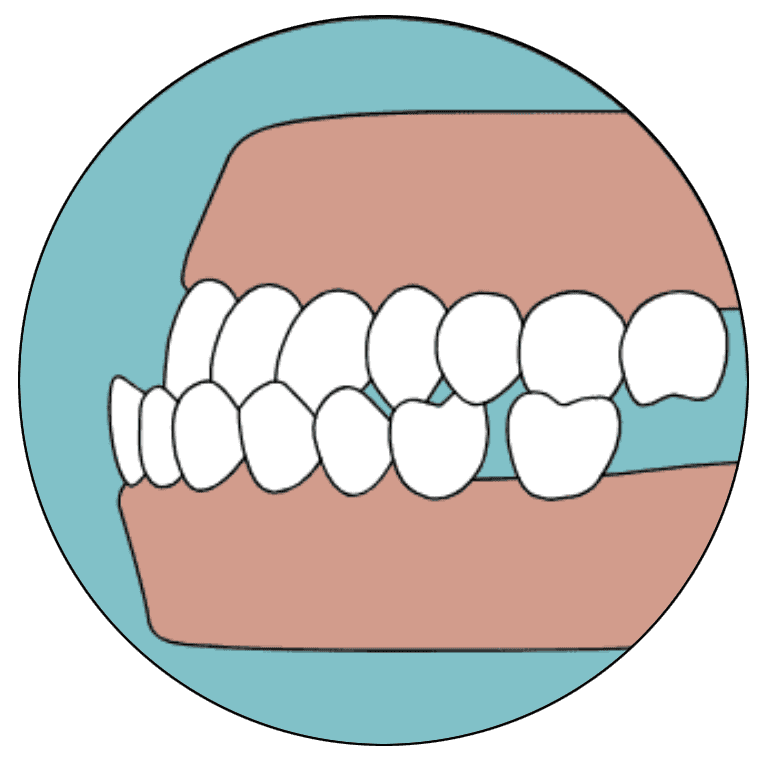
An underbite happens when your child’s lower teeth sit in front of the upper teeth when they bite down. Left untreated, it can affect speech, chewing, and jaw growth, not just appearance.
Dr. Taylor can tell which type your child has and recommend a plan. Underbites can be subtle. The most obvious signs are lower teeth that overlap the upper teeth and a prominent lower jaw, along with symptoms like trouble chewing, mouth breathing, or speech problems.
The best window for treating an underbite is roughly ages 7 to 10, while the jaw is still growing. Early treatment can guide jaw development, reduce the chance of later jaw surgery, create room for permanent teeth, and improve bite, breathing, and speech.
Every child gets a custom plan based on age, bite, and growth stage.
Waiting until the teen years or adulthood can mean jaw pain or TMJ problems, difficulty eating or speaking, the need for corrective jaw surgery, and lower self-confidence. Earlier treatment is generally easier.
Baby teeth make room for permanent teeth, so how they fall out—and when—can shape your child’s future bite.
Baby teeth form before birth, start appearing around six months, and are usually all in by about age three. Permanent teeth develop underneath them, and the root of each baby tooth dissolves as the permanent tooth moves in. A new tooth usually shows up within a month or two of the baby tooth falling out.
Most children lose their first baby teeth around age 6 and keep losing them until about age 12, with normal variation. Teeth usually fall out in the order they came in: lower front teeth, then upper front teeth, then the side teeth, then the molars. Wisdom teeth show up later, usually between ages 17 and 21.
An injury or decay (often from prolonged bottle use) can cause a baby tooth to come out early. The gap lets neighboring teeth drift in, which can crowd the permanent tooth when it tries to come in. Braces or an extraction may then be needed to correct the issue.
Genetics play a big role in timing, so early or late loss can be perfectly normal. But when a baby tooth stays in too long, the permanent tooth can come in behind it, creating a two-row look. Adult teeth that come in this way are often crooked and may need orthodontic correction.
If an adult tooth hasn’t appeared two to three months after a baby tooth is lost, see an orthodontist. We may recommend a space maintainer, a removable or fixed appliance that holds the gap open until the permanent tooth arrives. We typically use fixed space maintainers for younger children or back teeth and bond them to neighboring teeth. If a baby tooth is slow to fall out, we may recommend extracting it to make room.
Orthodontists hear this question all the time. Most children don’t need treatment as early as age 7, but the check-up at that age lets us decide whether to start early or wait. Most baby teeth are lost by age 13, and the jaws stop growing by the end of the teen years, so timing matters.
If a problem is developing, you can start treatment in Phase 1 around age 7, while your child still has baby teeth. We recommend it only when there is a clear benefit, such as the underbite and early tooth loss situations described above.
For most children, the best treatment window is about ages 9 to 12 for girls and 10 to 14 for boys, when the baby teeth are out, and the head and jaws are still growing.
Treatment is still possible after about age 16 or 17, but it often takes longer because growth is mostly finished. There’s no age limit for braces, and today’s options are more discreet than ever, including ceramic, colored, and clear choices. Adults are welcome too: see our adult braces page.
Ready to talk about braces? Our guide to kids braces in McAllen, Texas covers your options, how to prepare your child, what the first week feels like, what to eat, and what braces cost.
- Board-certified orthodontist. David Taylor has over 15 years of experience treating children and adults.
- Premier Invisalign Provider. Taylor is the Rio Grande Valley’s premier Invisalign Provider, an option many teens ask about.
- No referral needed. Book directly with us for a free consultation.
- Se habla español. Our team welcomes Spanish-speaking families. Visit our Spanish page.
Find us at 1400 E Expy 83 #155, McAllen, TX 78503.
“Dr. T & the whole staff are amazing, warm & caring environment. I get to see my baby smile now. Shes has gained so much confidence since starting treatment. Love you all & thank you so much.” -Cassandra W.
“10/10 overall experience, staff is very gentle & friendly. My teeth look great! 😁” – Kimberley N.
“I always had a great experience during my appointments, was always treated nicely and all the staff were very respectful and kind to me. They did a great job on my smile, and I’m so happy with the outcome!” – Paulina M.
These are just some reasons we’re the best orthodontist in the Rio Grande Valley.
But don’t just take our word for it. Read our reviews, then come in and find out how easy it can be to get a perfect smile!
No. You can book a free consultation with Dr. Taylor directly, with no referral needed. You, your child’s dentist, and Dr. Taylor make final treatment decisions together, so we’re happy to work alongside your dentist. Call 956.630.6166 or book online.
It’s still worth a checkup. Teeth that look straight can hide problems with jaw growth or how permanent teeth come in, and orthodontists specialize in spotting those. See the difference between an orthodontist and a dentist. Our consultation is free.
Not reliably. Some changes happen naturally as permanent teeth come in, but many bite problems, including underbites, don’t correct on their own and can get harder to treat once the jaw finishes growing. An early evaluation tells you whether to treat now or simply watch.
Long-term thumb or finger sucking can affect tooth and jaw development. If your child is still sucking a thumb or fingers as permanent teeth come in, have them checked. Dr. Taylor can tell you whether the habit is affecting their bite and what to do about it.
Front teeth that stick out are more likely to get injured, especially in active kids. Correcting them early can lower that risk and improve how the teeth, lips, and face fit together. Dr. Taylor can tell you whether your child needs treatment now or can wait.
Yes. We welcome patients of all ages, from children to teens and adults. Teens can often choose between braces and Invisalign Teen, depending on their case. Learn more about Invisalign Teen or compare Invisalign vs. braces for teens.

Call us or book your free consultation online. Our New Patient Coordinator will walk you through everything, so you and your child feel confident from day one.
Or complete the form below.
"*" indicates required fields


